Irrational numbers: what are they and how to justify

Let us start from rational numbers. For testing whether a given number is rational, one can write the number as the ratio of two integers – conceptually this is simple. But to claim the opposite is not that straight forward. How would you show that sqrt 2 (or pi) is irrational? If you just show number sqrt 2 does not equal to many of the ratios of two integers numerically, you made little progress to prove it is irrational.

Consider sqrt 2

sqrt 2 = 1.414 213 562 373 .. ..

followed by the sequence

{1, 1.4, 1.41, 1.414, 1.4142, 1.41421, 1.414213, .. .. .. }

as well as the sequence

{2, 1.5, 1.42, 1.415, 1.4143, 1.41422, 1.414214, .. .. .. }

Of the above two sequences, each has the limit as sqrt 2. We observe there is no interval on the real axis, such that all within that interval are irrational numbers.

To ask whether a number is irrational, the only way to make it meaningful, is to give the number in an exact form – either in radical numbers (like sqrt 2), or with an expression involving well known constant(s), e.g. pi + 2, where pi is the ratio (of a circle) of circumference to diameter. There are three simple rules that we can resort to when deciding whether a number is irrational or not, given as below:

(a) The square root of a non perfect-square number is always an irrational number;

Or: if the square root of an integer is not an integer, then it must be an irrational number.

Example: sqrt 2, sqrt 5

(b) An irrational number added to (subtracted from) a rational number, or multiplied by (divided by) a rational number (the multiplier or divisor is not 0), will always result in an irrational number.

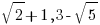
Example: sqrt 2 +1, 3 - sqrt 5
(c) If an arithmetic expression (only add/subtract/multiply/division) involves any count of rational numbers but only one irrational, and that irrational is not reduced to zero by a zero multiplier, then the result will always be an irrational number.

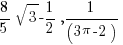
Example: pi + 2, 2 pi -1, and {8/5} sqrt 3 - {1/2}, 1/ (3 pi -2)

We have to do work sometimes in order to use these rules (a) (b) (c) : try simplifying the given expression while keeping the exact value.

Rule (a) shall be extended (as considering cubic roots, fourth power roots etc.) to the following. For a power root of n-th exponent (n is any integer), if the radicand is not a perfect n-th power number, then result of this power root must be an irrational number. So root{4}{8} is irrational since 8 is not x^4 where x is any integer).

To appreciate those rules, let us do a practice. Of the following numbers, which are rational, and which are irrational?

(i) (root{22}{22})^2, ~~~(ii) 2 (root{3}{13}) + {1/2} (root{6}{169}),

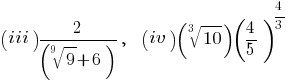
(iii) 2/ (root{9} 9 + 6), ~~ (iv) (root{3}{10}) (4/5)^{4/3}

In case you forget the definition of fraction exponent, please have a quick review on it. The answer to these questions is shown below.

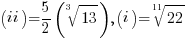
  • (i) (ii) are irrational numbers: (ii) = {5/2} (root{3}{13}), (i) = root{11}{22};
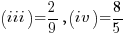
  • (iii) (iv) are rational numbers: (iii) = {2/9}, (iv) = {8/5} .

Suppose an expression results in a rational number. Only a slight change will bring it to an irrational number. For example, 2/ (sqrt 10 + 6) is an irrational number (since the square root of 10 is irrational, which adds to 6 to get a sum, then take reciprocal and then double). See how similar the form is to the given form (iii) !

In the next post, for the first rule — rule (a) — an example (sqrt 2) will be shown strictly as an irrational number (we not only know that rule, but also try to understand why the rule stands true).

Meanwhile, we note the constant pi is defined as a ratio (checking up the definition – if you want), and we say it is an irrational number. Why so? Find the explanation in the next post.
勾股定理的一个有趣证明

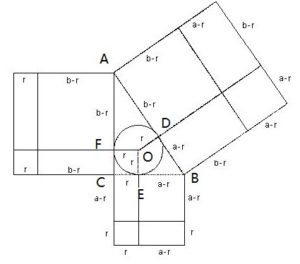
下图中,ABC是直角三角形;C是直角。如图所示是勾股定理的一个证明。您看明白了吗?

耐人寻味的是这里用到了直角三角形的内切圆,与三边(两直角边和一斜边)分别相切于三点 D,E,F。过这三个切点的半径把圆分成三部分。而每一部分都是对称的!由此首先:

c = (a-r) + (b-r) = a+b – 2r

其中 c 是斜边长,a, b 是两直角边长,r 是这内切圆的半径。

我们于是有

c2 = (a-r + b-r)2

为证勾股定理,余下的就是把上式的右边变化成 a2 + b2. 建立的方法是通过切割面积c2 利用面积相等把切割的小块与 a2 + b2 中的小块完全匹配。(记 O 是内切圆的中心. 注意 D,E,F 是三个切点。)

看一眼如下的推演:

c2 = (a+b-2r)2

c2 = (a+b)2 – 4r (a+b) + 4 r2

c2 = a2 + b2 + 2ab – 4r (a+b-r)

在上面式子中,划掉尾巴上的两项,就是勾股定理。所以我们只要证明:

2 ab = 4r (a+b-r)

即(ab)/2= r (a+b-r). 注意!直角三角形的面积是啥?是 (ab/2). 直角三角形ABC(被过三切点的半径)分成三块:四边形 OFAD,ODBE 还有OECF(正方形):面积分别是 r (b-r), r(a-r), 还有 r2. 加起来,ABC 的总面积不就是 r(a+b-r) ?由此(ab) /2 = r (a+b-r).

之所以说内切圆的使用耐人寻味,是因为在本证明中只是利用切点去分割三角形;割成的三小块:四边形 OFAD,ODBE 还有OECF(正方形)面积都与 r 有关。是不是很有趣?

啊哈! 证明毕。

Mysterious Unbalanced Sheets on Loans – story told by hunchbacked shopkeeper

Once there was a hunch-backed shopkeeper. And he told the following story:
(For readers at grade 6/7 level and up)

“Once I lent 100 dinars, 50 to a sheik from Medina and another 50 to a merchant from Cairo.

“The sheik paid the debt in four instalments, in the amount 20, 15, 10 and 5. .. .. Note that the total of his debt balance is 50 dinars.

1st Installment: Paid 20 & Still Owe 30
2nd installment: Paid 15 & Still Owe 15
3rd Installment: Paid 10 & Still Owe 5
4th Installment: Paid 5 & Owe 0
Total Paid 50 & Total Owe 50

“Meanwhile the merchants from Cairo also paid the debt of 50 dinars in four instalments, in the following amount: 20, 18, 3 and 9. And here is the balance sheet for his debt.

1st Installment: Paid 20 & Still Owe 30
2nd installment: Paid 18 & Still Owe 12
3rd Installment: Paid 3 & Still Owe 9
4th Installment: Paid 9 & Owe 0
Total Paid 50 & Total Owe 51

“But note his total owed is 51 dinars”, remarked by the hunchbacked shopkeeper; apparently this should not have occurred.

Using a bit math, can you help our shopkeeper to solve the mystery?

Think on your own first!

Then you might want to take a look at our explanation. Do you agree with us?

Sample Questions for Gauss Contests


Questions chosen from previous Gauss contests
Gauss contests are organized by the Centre of Education for
Math and Computing, University of Waterloo
Problem 1

In the addition shown, P and Q each represent single digits, and the sum is 1PP7. What is P + Q?

(A) 9 (B) 12 (C) 14 (D) 15 (E) 13


Problem 2

In the right-angled triangle PQR, we have that PQ = QR. The three segments QS, TU and VW are perpendicular to PR, and the segments ST and UV are perpendicular to QR, as shown. What fraction of triangle PQR is shaded?

(A) 3 ⁄ 16 (B) 3 ⁄ 8 (C) 5 ⁄ 16 (D) 5 ⁄ 32 (E) 7 ⁄ 32


Problem 3

A box contains a total of 400 tickets that come in five colours: blue, green, red, yellow, and orange. The ratio of blue to green to red tickets is 1 : 2 : 4. The ratio of green to yellow to orange tickets is 1 : 3 : 6. What is the smallest number of tickets that must be drawn to ensure that at least 50 tickets of the same colour have been selected?

(A) 50 (B) 246 (C) 148 (D) 196 (E) 115


Problem 4

Greg, Charlize, and Azarah run at different but constant speeds. Each pair ran a race on a track that measured 100 m from start to finish. In the first race, when Azarah crossed the finish line, Charlize was 20 m behind. In the second race, when Charlize crossed the finish line, Greg was 10 m behind. In the third race, when Azarah crossed the finish line, how many metres was Greg behind?

(A) 20 (B) 25 (C) 28 (D) 32 (E) 40


Problem 5

In right-angled, isosceles triangle FGH, segment FH = √̅8. Arc FH is part of the circumference of a circle with centre G and radius GH. The area of the shaded region is

(A) π – 2; (B) 4 π – 2 (C) 4 π – (1 ⁄ 2) √̅8 ; (D) 4 π – 4 (E) π – √̅8

The symbol π — where does it come from?

Where does the symbol π come from?

In 1652, William Oughtred used π to refer to the periphery of a circle (in his expression, the ratio of circumference-to-diameter of a circle is π ⁄ δ, the latter referring to diameter).

In 1665, Jonh Wallis used a Hebrew letter mem(mem) to equal the ratio of one-quarter of circumference to diameter of a circle. (This letter plays the role as of “M” in Latin alphabets, but look how close its shape resembles a quarter of a circle, as well as the Greek letter pi !)

In 1705, William Johns used π to represent the ratio of circumference-to-diameter of a circle (believed to be first use with exactly same meaning as in today) .

From 1736, Leonard Euler, both famous and a prolific writer in mathematics works, spread the use of π in his publications.

Counting from the first relevant use, the symbol π has already had a history of more than 360 years!

On the Patterns (2)

On the Patterns


(2) Number Patterns * Numbers, Colours and Stars


Start by taking a look at the following chart.

1

2

★3

4

5

6

7

8

9

10

11

12

13

★14

15

16

17

18

19

20

21

22

23

24

★25

26

27

28

29

30

31

32

33

34

35

★36

37

38

39

40

41

42

43

44

45

46

★47

48

49

50

51

52

53

54

55

56

57

★58

59

60


First, let us look up to the stars:


What pattern is followed for the placement of stars ?

Each number besides the star is increased by ____. (Fill in the blank)


Following this pattern, the three more numbers that are besides and that

comes after 58 are: __ , __ , and __.


Now go back to the chart, and let us look at the coloured cell (those coloured by yellow)


What can you do to follow the yellowed-coloured cell? Please colour the numbers on the chart by continue the pattern that you discovered.


What are the common features of these yellow cells? Colour some new cells, and explain how, by colouring these cells, you have followed and extended the pattern which is already in the chart.

Take a moment to think. You can answer these questions!