Let us start from rational numbers. For testing whether a given number is rational, one can write the number as the ratio of two integers – conceptually this is simple. But to claim the opposite is not that straight forward. How would you show that  (or
(or  ) is irrational? If you just show number does not equal to many of the ratios of two integers numerically, you made little progress to prove it is irrational.
Consider

followed by the sequence
{1, 1.4, 1.41, 1.414, 1.4142, 1.41421, 1.414213, .. .. .. }
as well as the sequence
{2, 1.5, 1.42, 1.415, 1.4143, 1.41422, 1.414214, .. .. .. }
Of the above two sequences, each has the limit as . We observe there is no interval on the real axis, such that all within that interval are irrational numbers.
To ask whether a number is irrational, the only way to make it meaningful, is to give the number in an exact form – either in radical numbers (like ), or with an expression involving well known constant(s), e.g.  , where is the ratio (of a circle) of circumference to diameter. There are three simple rules that we can resort to when deciding whether a number is irrational or not, given as below:
(a) The square root of a non perfect-square number is always an irrational number;
Or: if the square root of an integer is not an integer, then it must be an irrational number.
Example: 
(b) An irrational number added to (subtracted from) a rational number, or multiplied by (divided by) a rational number (the multiplier or divisor is not 0), will always result in an irrational number.
Example: 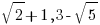
(c) If an arithmetic expression (only add/subtract/multiply/division) involves any count of rational numbers but only one irrational, and that irrational is not reduced to zero by a zero multiplier, then the result will always be an irrational number.
Example:  and
and 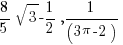
We have to do work sometimes in order to use these rules (a) (b) (c) : try simplifying the given expression while keeping the exact value.
Rule (a) shall be extended (as considering cubic roots, fourth power roots etc.) to the following. For a power root of n-th exponent (n is any integer), if the radicand is not a perfect n-th power number, then result of this power root must be an irrational number. So  is irrational since 8 is not
  where x is any integer).
To appreciate those rules, let us do a practice. Of the following numbers, which are rational, and which are irrational?

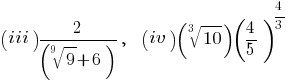
In case you forget the definition of fraction exponent, please have a quick review on it. The answer to these questions is shown below.
- (i) (ii) are irrational numbers:
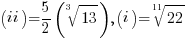 ;
; - (iii) (iv) are rational numbers:
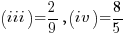 .
.
Suppose an expression results in a rational number. Only a slight change will bring it to an irrational number. For example,  is an irrational number (since the square root of 10 is irrational, which adds to 6 to get a sum, then take reciprocal and then double). See how similar the form is to the given form (iii) !
In the next post, for the first rule — rule (a) — an example () will be shown strictly as an irrational number (we not only know that rule, but also try to understand why the rule stands true).
Meanwhile, we note the constant is defined as a ratio (checking up the definition – if you want), and we say it is an irrational number. Why so? Find the explanation in the next post.
